
Grouping plants
Why three is more convincing than one — A single plant in a room can look like an afterthought. A considered group of three feels like the room was always supposed to look like that.
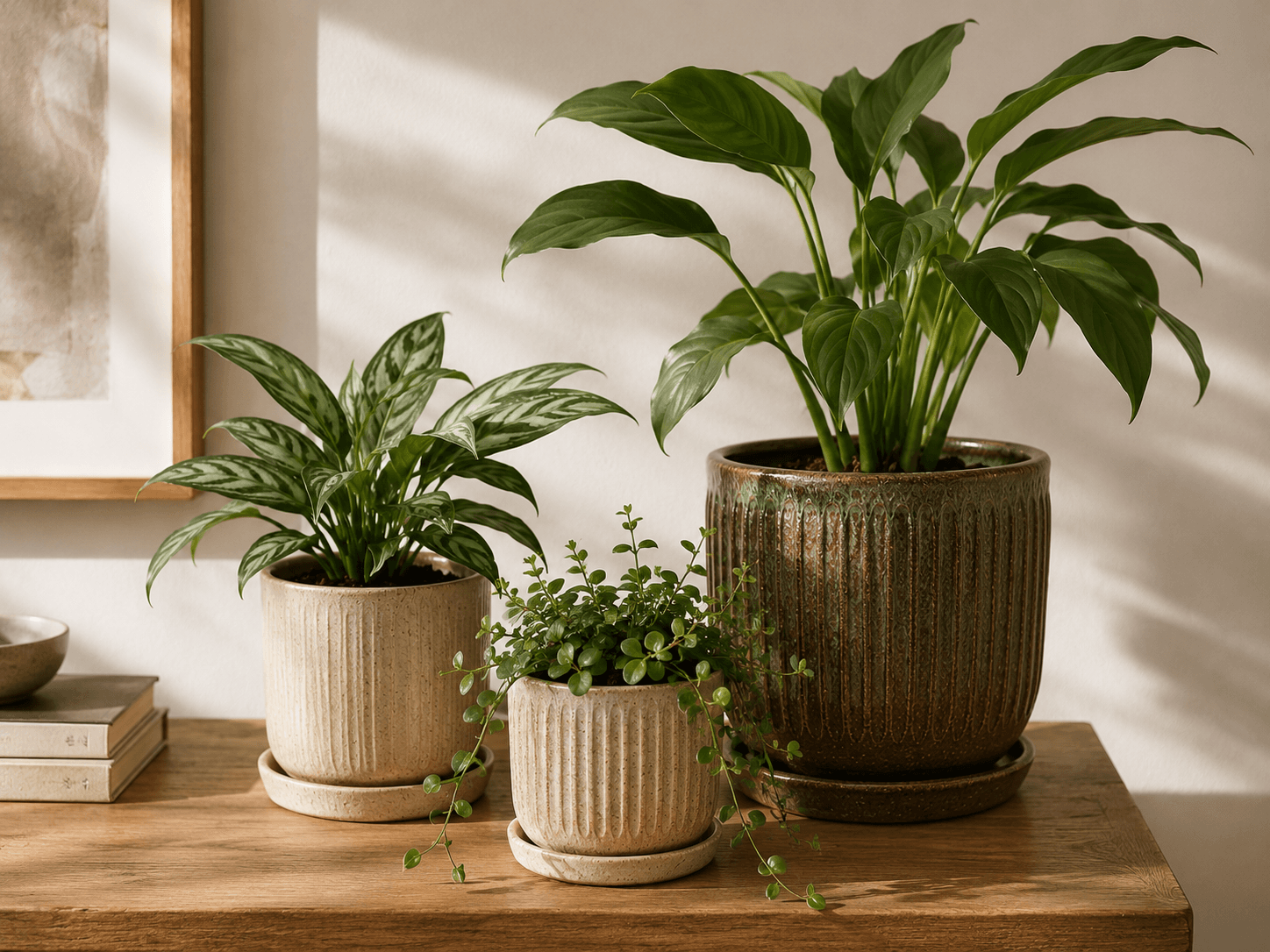
Odd numbers read as intentional
Three plants together look considered. Two look like a pair. Four looks like you ran out of ideas at three but had one more pot. It's a simple principle from art and design that applies just as well to a living room as to a painting: odd groupings feel natural, even groupings feel formal.
Five works too, in a larger space. The principle breaks down at seven or more — at that point you're in plant-collection territory, which can look wonderful but requires more commitment and a better eye for composition. For most rooms, three is the number to aim for.
Vary the height and texture
A group works best when the three plants have different heights, leaf sizes, and textures. Something tall at the back or side, something medium with a different leaf shape, and something low or trailing to anchor or soften. The contrast between a large-leaved plant and a fine-textured one is more interesting than three plants of similar form.
You don't need to be rigid about it. The principle is variety, not formula. If your three plants all want the same light conditions and are visually distinct, they'll work. What tends to look flat is three similar-sized plants in similar pots in a row — even if each plant is lovely individually.
Don't match the pots
Matching pots — three identical terracottas in a row — looks more like a shop display than a home. Slight variation reads as more personal: different glazes in the same colour family, or a mix of terracotta and stoneware, or pots at different heights using books or a small stool to vary levels.
The variation doesn't have to be dramatic. A plain terracotta next to a speckled stone-coloured pot next to one of our darker glazed pots looks like things were collected over time, which is more convincing than things that were bought together. Plants accumulate in a home; the display should feel like it did too.
Keeping a mixed group alive
Grouping plants by their watering needs is easier than it sounds. Most tropical foliage plants — pothos, philodendrons, monsteras — share broadly similar requirements: bright indirect light, water when the top inch dries out, not much fuss. Grouping these together means one checking routine covers them all.
Succulents and cacti are better grouped with each other than mixed into a tropical display — they want far less water and more direct sun. Mixing a cactus with a calathea means one will always be getting the wrong conditions. Keep the care requirements compatible and a group becomes easier to maintain, not harder.